


How Water Filters Lower Household Emissions — And Why It's One of the Easiest Wins in Your Home
Most households looking to cut emissions focus on the obvious targets — driving less, switching to LEDs, adjusting the thermostat. The bottled water habit rarely makes the list. It should. A detailed lifecycle analysis puts bottled water's environmental impact at approximately 3,500 times higher than tap water when you account for greenhouse gas emissions, fossil fuel use, and land use across the entire supply chain. Switching to filtered tap water doesn't just reduce plastic waste — it cuts one of the most carbon-intensive consumer habits in the home, with no lifestyle sacrifice required.
Bottled water generates up to 3,500× more emissions than tap water across its full lifecycle. A home filter — particularly a gravity-fed benchtop unit like the Trinity — eliminates that entire chain with no plumbing, no power, and no installation. The substitution is the win. Everything else is optimisation.
📋 Table of Contents
- Why bottled water is a surprising household emissions source
- Filter types and their environmental footprints
- The real environmental benefits of switching to filtered water
- Choosing and maintaining filters to maximise impact
- Why the Trinity is the right choice for most Australian households
- Frequently Asked Questions
Why Bottled Water Is a Surprising Household Emissions Source
The 3,500× figure comes from a rigorous lifecycle study conducted in Barcelona, measuring every stage of the bottled water supply chain against its tap water equivalent. The gap is so large because bottled water isn't just water — it's a petroleum-derived container, a manufacturing process, a cold chain, and a long-haul freight operation, all wrapped around something that already comes out of your tap.
Petroleum is extracted and refined to produce PET plastic resin. That resin is moulded into bottles at energy-intensive manufacturing facilities. Water is extracted, treated, and bottled at a processing plant. Finished bottles are palletised, refrigerated, and transported hundreds or thousands of kilometres. You buy them, chill them again at home — then throw them away. Every step burns fossil fuels. The transportation leg alone is significant because water is heavy and moves by truck across long distances.
The plastic packaging compounds the problem further. When you multiply a household's weekly bottled water purchase across a full year, the emissions add up fast — and visibly. Most households that make the switch report a dramatic reduction in bin volume within the first month alone.
Filter Types and Their Environmental Footprints
Not all filters carry the same footprint, and the differences matter when you are trying to make a genuine reduction. Here is how the main filter technologies compare.
| Filter Type | Contaminants Removed | Energy Use | Waste Generated | Overall Footprint |
|---|---|---|---|---|
| Gravity benchtop (Trinity) | Fluoride, chlorine, chloramine, heavy metals, bacteria, microplastics | Zero — no power required | Minimal — cartridge replacements only | Lowest |
| Activated carbon (jug/benchtop) | Chlorine, VOCs, THMs, odour | Very low | Minimal | Low |
| Reverse osmosis | Nitrates, PFAS, heavy metals | Moderate | Wastewater produced | Low (still beats bottled) |
| Bottled water | Varies by brand | Very high (full supply chain) | Hundreds of single-use bottles/yr | 3,500× higher than tap |
Gravity-fed benchtop filters
Gravity-fed filters — like the Trinity — use no electricity whatsoever. Water passes through the filter stages under its own weight. That means zero operational energy cost and zero wastewater. Combined with the broad-spectrum contaminant removal across Trinity's three stages (ceramic dome, activated alumina and proprietary KDF blend, mineral stones), a gravity-fed benchtop unit delivers the most environmental efficiency of any filter type available for home use.
Activated carbon filters
Activated carbon is the workhorse of home filtration and handles chlorine, trihalomethanes, and VOCs at very low energy cost with no liquid waste. For most city households with decent municipal water quality, carbon filtration alone is sufficient — and its footprint is minimal. The limitation is fluoride: standard activated carbon does nothing to remove it.
Reverse osmosis
RO removes nitrates, PFAS, and heavy metals that carbon cannot catch, making it the right call for households with specific contamination concerns or bore water. The trade-off is operational energy and wastewater produced during filtration. That said, RO's overall emissions are still dramatically lower than continued bottled water reliance — the avoided emissions from eliminating plastic bottle manufacturing and transport far outweigh the extra energy the system uses.
✅ Pro tip: Match your filter to your actual water quality report — not the worst-case scenario. If your municipal water scores well on heavy metals and nitrates, an activated carbon or gravity benchtop filter is all you need. Choosing RO when you don't need it adds energy use without meaningful benefit.
The Real Environmental Benefits of Switching to Filtered Water
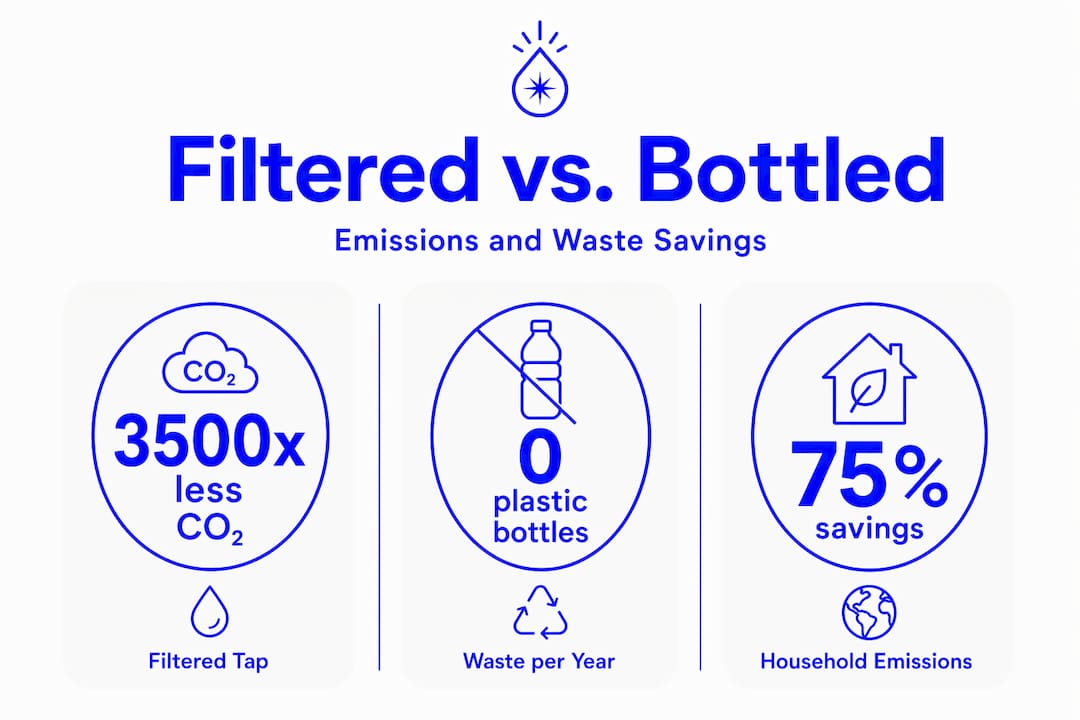
The environmental case for home filtration is primarily a substitution story. You are not just filtering water — you are replacing one of the most carbon-intensive consumer habits in the home with something that costs a fraction of the emissions and a fraction of the money. The health benefits run in parallel: filtered tap water removes the same contaminants that drive people to buy bottled water in the first place. You get cleaner water and lower emissions. There is no trade-off.
Here is a practical sequence for making the substitution stick:
- Audit your bottled water spending. Count how many bottles or multipacks your household buys per month. This gives you a concrete baseline to measure against.
- Install a point-of-use filter. A gravity-fed benchtop filter like the Trinity is the fastest path to clean, great-tasting water from your tap — no plumbing changes, no power, no installation.
- Get a reusable bottle for on-the-go. The HydroWand filtered bottle eliminates single-use plastic across every trip outside the home, not just at the kitchen tap.
- Stop buying cases. Cancel the delivery or stop buying multipacks. This is the step that actually moves the needle on your household's carbon output.
- Track the difference. After 90 days, compare your plastic waste output. Most households report a dramatic visible reduction in bin volume alone.
✅ Renting? A gravity-fed benchtop filter or a filtered water pitcher delivers the full emissions benefit with zero installation required — no permission needed, no plumbing, no tools.
Choosing and Maintaining Filters to Maximise Impact
Picking the right filter is only half the job. How you maintain it determines whether your system stays genuinely low-emission over time or quietly becomes a source of unnecessary waste.
What actually matters for long-term sustainability:
- Replace cartridges on schedule. A clogged or expired cartridge doesn't just perform poorly — it can become a breeding ground for bacteria. Trinity's KDF and activated alumina cartridge runs 6–8 months; the ceramic dome and mineral stones run annually. Set a calendar reminder.
- Clean your ceramic dome monthly. A quick scrub under running water extends ceramic life significantly and keeps flow rate high. This is one of the easiest maintenance steps in any filter system.
- Don't over-specify. Running an RO system when activated carbon or a gravity benchtop filter would do the job wastes energy every single day. Check your water utility's annual quality report first — it's free and publicly available.
- Buy cartridges in bulk when possible. Consolidated shipping reduces per-unit delivery emissions, and you will always have a replacement on hand before your current cartridge expires.
A quality home filter system costs a fraction of a year's bottled water spending. Trinity's annual cartridge cost is well under what most households spend on bottled water in a single month. Sustainability and savings point in exactly the same direction here.
Why the Trinity Is the Right Choice for Most Australian Households
Trinity Fluoride Filter — Best for Most Australian Households
Trinity is the only gravity-fed benchtop filter in Australia that removes fluoride, chlorine, chloramine, heavy metals, bacteria, and microplastics in a single unit — with zero power and zero plumbing required. Its activated alumina and proprietary KDF blend delivers up to 90% fluoride reduction. Most fluoride filters use activated alumina alone; Trinity's KDF component handles chlorine, chloramine, and heavy metals in the same cartridge.
- Up to 90% fluoride removal — activated alumina + proprietary KDF blend
- Removes chlorine, chloramine, lead, mercury, cadmium, arsenic
- Ceramic dome filters bacteria, microplastics, rust, and cysts
- Mineral stones add calcium, magnesium, and potassium back
- No power, no plumbing, no installation — benchtop, renter-friendly
- Replaces bottled water entirely — eliminating 500+ single-use bottles per person per year
- Lifetime filter guarantee + free Australian delivery
Frequently Asked Questions
Water filters lower household emissions primarily by replacing bottled water, which carries an environmental impact up to 3,500 times higher than tap water across its full lifecycle. Eliminating the plastic production, bottling, and transportation chain from your consumption removes one of the most carbon-intensive habits in the home — and a gravity-fed benchtop filter like the Trinity does it with zero operational energy.
Yes. Switching from bottled water to a home filter eliminates hundreds of single-use plastic bottles per person each year. For a family of four, that's typically 1,500–2,000 bottles annually that were never manufactured, never transported, and never sent to landfill or recycling.
Gravity-fed benchtop filters have the lowest operational footprint because they use no electricity at all. Among powered filters, activated carbon has a minimal footprint due to low energy use. Reverse osmosis uses more energy and produces some wastewater, but still results in a dramatically lower household footprint than buying bottled water regularly.
No. While RO systems consume more energy than other filter types, the avoided emissions from eliminating plastic bottle manufacturing and transportation far outweigh the extra operational energy. RO remains a much greener choice than bottled water dependence — though for most Australian city households, a gravity-fed filter handles everything they need without the energy cost.
Replace cartridges according to the manufacturer's rated capacity. For Trinity, the activated alumina and KDF cartridge runs every 6–8 months; the ceramic dome and mineral stones are replaced annually. Staying on schedule prevents performance degradation and ensures you are never running an expired filter that needs early replacement.
Yes — and Trinity is specifically designed for this. It sits on your benchtop, requires no plumbing, no installation, and no landlord permission. You get the full emissions and health benefit of filtered water in a rented home, apartment, or shared house from day one.
Ready to Ditch Bottled Water for Good?
Trinity sits on your benchtop, needs no installation, and starts filtering from day one. No plumbing. No power. No single-use plastic. Over 100,000 Australian households have already made the switch.
Shop Trinity Shop HydroWandMore from the HolyH₂O Hydration Guide
This article is intended for general informational purposes. Always check your local water utility's annual quality report to determine which contaminants are present in your supply before selecting a filtration system.